Beyond Scientific Silos: WMS and ISM Join Forces on Extracellular Vesicles
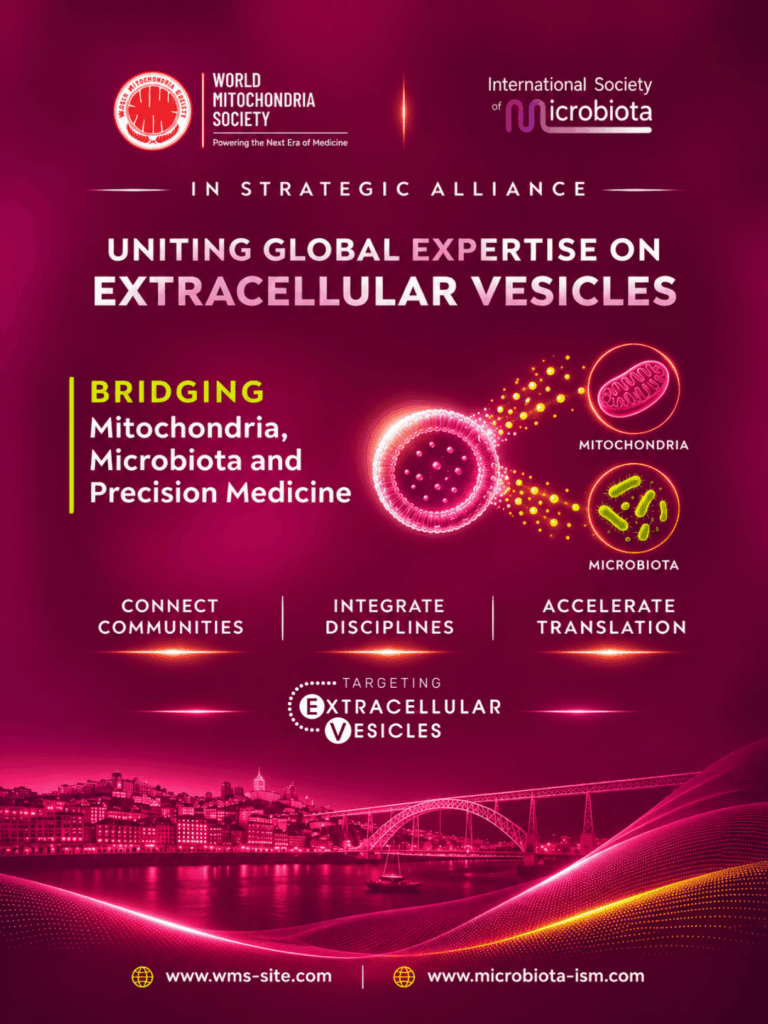
Two scientific societies. Different expertise. One shared ambition: connecting scientific communities to advance extracellular vesicle research and its translation into medicine.
The World Mitochondria Society (WMS) and the International Society of Microbiota (ISM) are strengthening their scientific collaboration around one of the most fascinating challenges in modern biology: understanding how cells and biological systems communicate through extracellular vesicles (EVs).
Why bring these communities together?
Mitochondria, microbiota, immunity, metabolism and disease are often investigated by separate scientific communities. Yet biological processes do not operate in isolation.
Extracellular vesicles offer an important opportunity to investigate the molecular signals connecting these systems.
The challenge is no longer simply to identify extracellular vesicles. It is to understand where they come from, what messages they carry, which cells receive them, and what biological consequences they produce.
Answering these questions requires expertise that extends far beyond any single research discipline.
Connecting expertise to accelerate discovery
Through their joint Extracellular Vesicles Task Force and the Targeting Extracellular Vesicles initiative, WMS and ISM aim to create new connections between mitochondrial researchers, microbiologists, EV specialists, immunologists, clinicians, bioengineers, bioinformaticians and biotechnology innovators.
This diversity is essential.
Mitochondrial biology can help explain the relationship between cellular metabolism, stress and vesicle-associated signaling. Microbiota research brings new perspectives on microbial vesicles, host–microbe interactions and systemic communication. EV specialists contribute the methods needed to characterize vesicles and investigate their functions.
Together, these perspectives can generate questions and collaborations that individual disciplines might overlook.
From biological communication to clinical impact
The promise of extracellular vesicles extends to biomarker discovery, disease monitoring, therapeutic delivery and precision medicine.
But important challenges remain: identifying vesicle origins, distinguishing vesicle subpopulations, demonstrating biological functions, improving reproducibility and establishing clinical relevance.
Scientific progress will depend not only on better technologies, but also on bringing the right expertise together to ask better questions.
This is the strategic ambition behind the WMS–ISM collaboration.
Not simply to connect two societies, but to encourage their members to work across traditional boundaries, develop collaborative research and help transform promising discoveries into scientifically validated clinical opportunities.
Connect communities. Integrate disciplines. Accelerate translation.
From isolated discoveries to a shared understanding of biological communication.