Can Bacterial Vesicles Talk to Our Mitochondria?
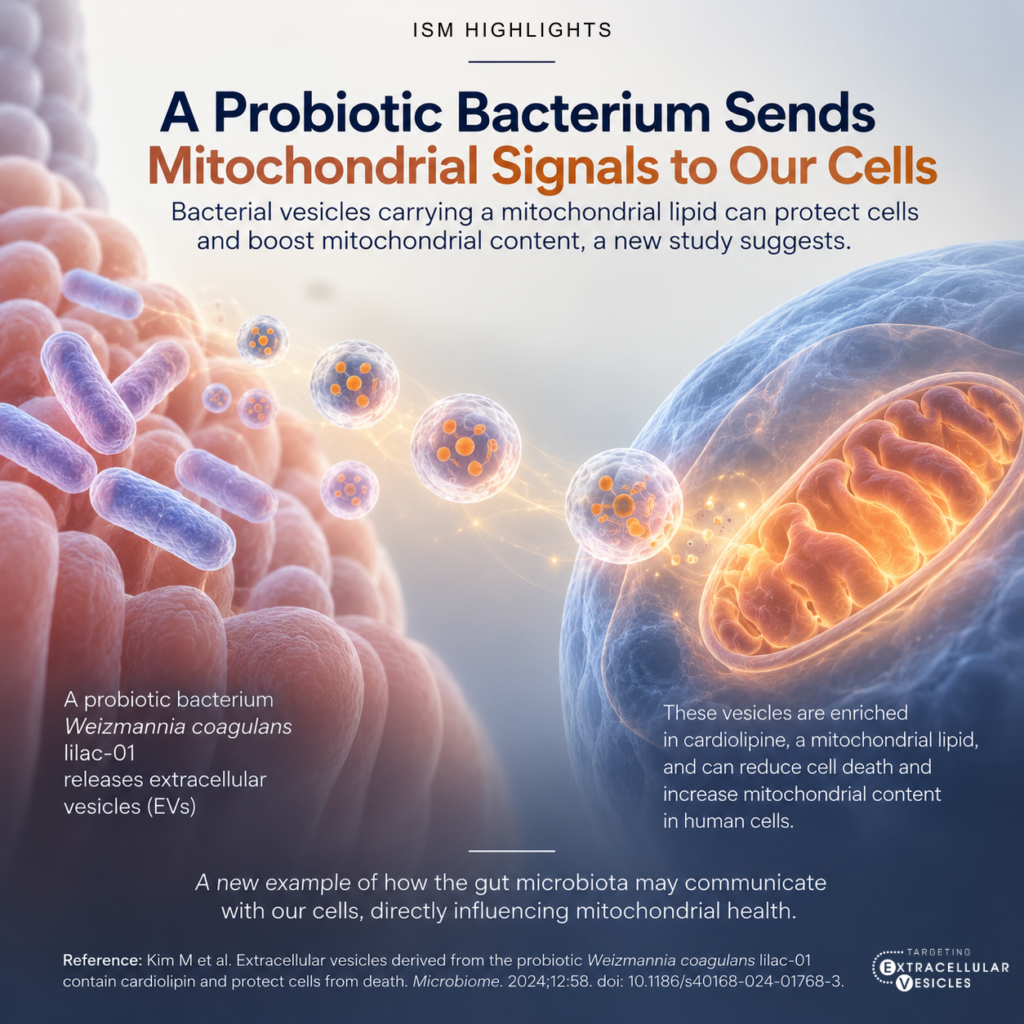
A probiotic-derived signal may directly influence mitochondrial content and cell survival, opening a new window on microbiota–mitochondria communication.
How does the microbiota communicate with our cells? We usually think first about metabolites, but bacteria can also release tiny biological packages called extracellular vesicles, or EVs, carrying lipids and other molecular signals.
A study investigating the probiotic bacterium Weizmannia coagulans lilac-01 found that these extracellular vesicles contain phosphatidylglycerol and cardiolipin. Cardiolipin is particularly interesting because it is a lipid strongly associated with mitochondrial membranes and mitochondrial function.
When these bacterial vesicles were added to primary rat microglia in vitro, they reduced cell death. In senescent human dermal fibroblasts, the same vesicles increased mitochondrial content, although mitochondrial membrane potential was not significantly changed.
The findings are still preliminary, but the concept is important. They suggest that bacteria may influence host mitochondria not only through soluble metabolites, but also by releasing extracellular vesicles carrying biologically active molecules.
This raises a broader question for the microbiota field. Could bacterial extracellular vesicles represent one of the missing messengers connecting microbial activity with mitochondrial function, cellular resilience and ageing?
The study does not yet demonstrate that the same effects occur in humans or inside the body, and it does not establish a therapeutic effect. However, it adds another layer to the emerging dialogue between the microbiota and mitochondria.
The message is simple: the microbiota may communicate with our cells through more routes than we previously thought, and mitochondria may be one of the key targets receiving these microbial signals.
Reference: Minamida K, Taira T, Sasaki M, et al. Extracellular vesicles of Weizmannia coagulans lilac-01 reduced cell death of primary microglia and increased mitochondrial content in dermal fibroblasts in vitro. Bioscience, Biotechnology, and Biochemistry. 2024;88(3):333–343.
For more information:
Read the full news here
Read the news on LinkedIn